
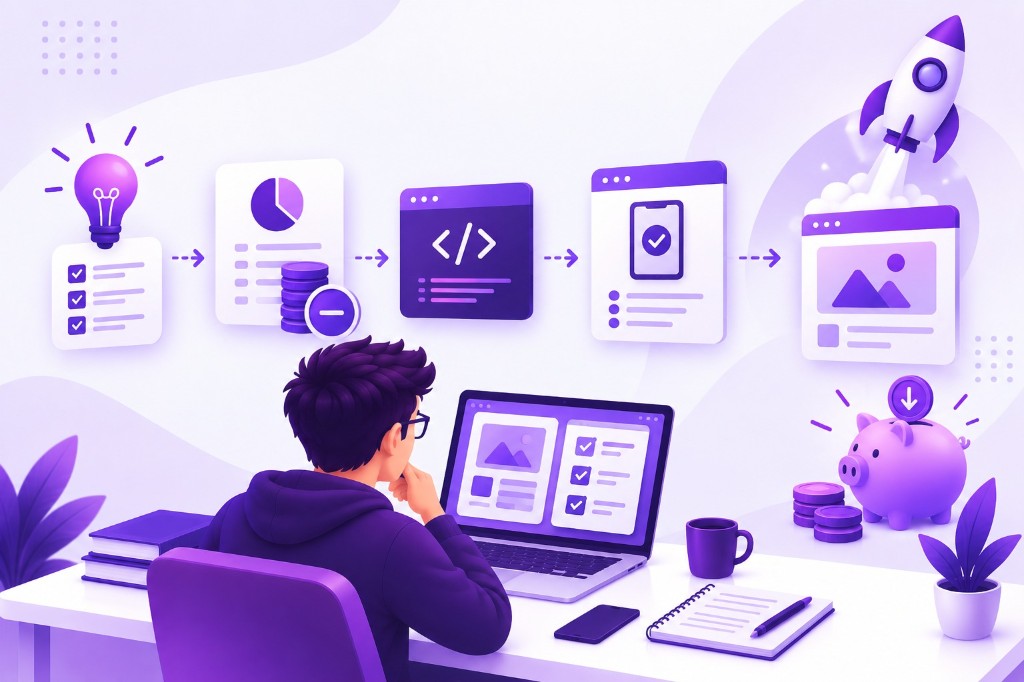
Overspending often starts before implementation. A broad audience, an unclear problem, or an impressive feature list can make a project expand without producing better evidence. The aim is to create the smallest credible test of value while keeping its limitations visible to the people using and funding it.
Decide what the MVP must prove
Write your central assumption as a sentence that could be wrong. For example, independent tutors will use a simple scheduling tool because arranging lessons through messages takes too much time. That assumption contains a specific audience, a problem, and a proposed reason to change behaviour.
Now identify the evidence you need. Interviews may establish that scheduling is frustrating, but they do not prove that tutors will adopt your product. A prototype can test whether the proposed journey is understandable. A limited live pilot can test repeated use. Choose the experiment that addresses your uncertainty rather than defaulting to a complete application.
Reduce scope around a complete journey
Small does not mean fragmented. A scheduling MVP might allow a tutor to create availability, share a booking link, and confirm a lesson. Advanced analytics, a marketplace, multiple subscription tiers, and custom themes can wait if they do not help test the central assumption.
Keep the necessary support for that journey. If a booking can fail, the user needs to understand what happened. If someone must approve a request manually, make that handoff clear. Removing essential feedback or access controls to reduce the feature count creates a confusing product rather than a focused experiment.
Choose what to buy, reuse, or handle manually
An MVP rarely needs a custom implementation of every supporting function. Existing authentication, payment, or messaging services may be appropriate if their constraints fit the pilot. Compare integration effort and ongoing costs before selecting them. A tool that is quick to connect can still be difficult to replace later.
Some back-office steps can remain manual during validation. A person might approve onboarding requests or prepare a report while demand is uncertain. Document these tasks and their capacity limits. Manual work is a conscious experiment design choice, not a reason to hide effort when evaluating whether the product can scale.
Build a budget around uncertainty
Separate discovery, design, implementation, testing, and pilot support in the estimate. Ask which assumptions could change the cost: an unavailable integration, messy source data, or an unexpected permission model. A useful estimate makes those uncertainties visible instead of presenting a precise total based on incomplete information.
Set a review point before adding more scope. You might agree to review the prototype after representative users attempt the core task. Decide in advance what would justify continuing, simplifying, or stopping. This protects the budget because the team has permission to change direction when evidence contradicts the original idea.
Example: a focused appointment product
Suppose the first concept includes booking, video calls, invoicing, reviews, a provider directory, and automated marketing. Each feature introduces work and new assumptions. If the immediate question is whether providers will share a booking link, only a small part of that platform is needed to learn.
A narrower pilot could support one provider type, one appointment format, and a simple confirmation process. After several real bookings, the team can inspect abandonment, support requests, and repeat usage. If providers never share the link, building a review system will not solve the adoption problem. The pilot should expose that issue early.
Track the full cost of learning
Include the time spent recruiting participants, answering questions, correcting data, and analysing feedback. Hosting and third-party usage are also part of the experiment. A product that costs little to build but requires constant manual intervention may still be an expensive way to test demand.
Keep the measurement simple. Track completed journeys, recurring use, and the reasons people stop. Avoid treating sign-ups as proof of value when the important action happens later. Combine counts with conversations so you understand whether a failure reflects the design, the audience, or a problem that was never urgent enough to solve.
A lean MVP planning checklist
- Name one audience and one problem that matters to that audience.
- Write the assumption and the evidence that would challenge it.
- Define a complete core journey and an explicit out-of-scope list.
- Identify manual steps, external services, and ongoing expenses.
- Agree a spending limit and a review date before expanding.
- Keep ownership of accounts, source files, and product decisions clear.
Use the out-of-scope list during every review. New ideas are not automatically bad, but each one should compete with the original learning objective. Put future features into a separate backlog rather than allowing them to quietly become conditions for launching the pilot.
Before approving a new feature, write down which uncertainty it resolves and how you will observe the result. If nobody can answer those questions, keep it outside the first release. This protects both the budget and the clarity of the experiment.
Frequently asked questions
Is the cheapest quote the best choice for an MVP?
No. Compare what the quote includes, what the MVP will prove, and what happens after delivery. A low price can omit testing, handover, or essential integration work. Look for a proposal that reduces uncertainty and produces evidence within a controlled budget.
Can an MVP be built without a full application?
Yes. Depending on the question, a clickable prototype, a manual service, or a narrow landing-page experiment may be sufficient. Be clear about what that experiment can and cannot demonstrate. Interest in an idea is different from evidence of sustained use.
When should the budget increase?
Increase investment when the pilot produces evidence that supports a specific next step. That might mean better retention, repeated customer demand, or a clear operational bottleneck. Tie additional scope to observed behaviour rather than adding features simply because the first version exists.