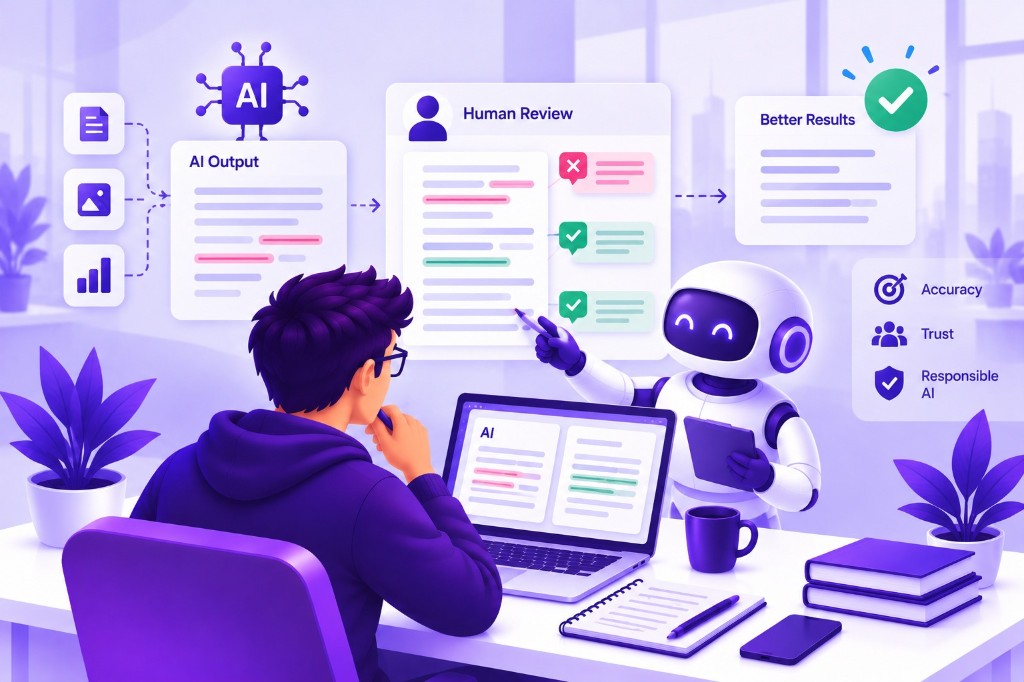
AI can help produce code and suggest improvements, but those capabilities do not establish that the result is correct. The reviewer needs enough context to question the output and enough evidence to decide whether it is ready. A useful review process is specific, repeatable, and proportionate to the consequences of failure.
Review the requirement before the implementation
Start by checking whether the requested behaviour is clear. A statement such as users can manage requests leaves many questions unanswered. Which users? Which requests? Can an approved request be changed? The code may implement one interpretation correctly while still solving the wrong business problem.
Use acceptance criteria and examples to reduce ambiguity. Describe an ordinary case and at least one important exception. When a generated change appears to contradict the requirement, resolve the disagreement explicitly. Do not assume that a confident explanation from the same tool is independent verification of its work.
Inspect important design decisions
Review how the change fits the application's structure. Identify where business rules live, how data is stored, and which components depend on the behaviour. A solution that works locally may create duplication or a hidden coupling that makes future changes difficult.
Ask the developer to explain the approach in plain language. The explanation should identify trade-offs rather than repeat the tool's output. If nobody can describe why a dependency was introduced or how a permission is enforced, the change needs more investigation. Maintainability depends on understanding, not only on passing a demonstration.
Test permissions and data handling
Access rules deserve deliberate attention. Verify that the server checks whether a user may read or change a record. A hidden interface control is not sufficient. Include tests involving another user's record and roles with different privileges, using an environment appropriate for the assessment.
Review the handling of inputs, uploaded files, secrets, and logs. Check what information is sent to external services and whether that use is appropriate. AI-generated code can repeat patterns that do not fit the project's context. The reviewer must connect general implementation techniques to the actual system and its responsibilities.
Example: reviewing an approval feature
Suppose AI produces a screen where a manager can approve a request. The visible flow works, but review reveals that the endpoint accepts any signed-in user and that a repeated submission creates duplicate notifications. Neither issue is obvious from watching one successful click.
A meaningful review checks role enforcement, the allowed state transition, and the behaviour of repeated requests. It also asks what happens if the request changes while the manager is reviewing it. These are business questions expressed through software behaviour, which is why review requires context beyond the code's appearance.
Use tests that challenge the implementation
Tests should verify independently defined expectations. A generated test that copies the implementation's assumptions may pass while protecting the wrong behaviour. Review what the test is trying to prove and whether a realistic failure would cause it to fail.
Combine appropriate automated checks with manual task review. Unit tests can cover rules, integration tests can exercise connected components, and user testing can reveal confusing interactions. The necessary mix depends on the change. Adding large numbers of trivial tests does not compensate for missing the main risk or business requirement.
Keep changes small and traceable
Large generated changes are difficult to inspect because unrelated decisions arrive together. Break work into coherent steps with a clear purpose. Record important assumptions and keep a history that allows the team to compare versions or reverse a problematic change.
Ask for review notes that explain what was checked and what remains uncertain. This does not need to become a lengthy report for every edit. The evidence should be proportionate, but it should be specific enough for another person to understand the decision. Transparency helps the team move quickly without losing accountability.
Review operational readiness as well
Code review is not the entire release process. Confirm that the application can be deployed, monitored, supported, and recovered in the intended environment. Check configuration and external dependencies. A feature can be technically correct but operationally incomplete if nobody knows how to respond when it fails.
Include the business owner in acceptance of the main journey. They can confirm whether the result fits the work, while technical reviewers assess implementation concerns. These responsibilities complement each other. Neither a business demonstration nor a technical checklist alone provides the complete picture of readiness.
Human review checklist
- The expected behaviour and important exceptions are understood.
- Architecture and dependencies have a reason that the team can explain.
- Access controls and data handling match the system's responsibilities.
- Tests challenge business rules rather than mirror generated code.
- Changes are traceable and significant limitations are documented.
- Release, support, and recovery arrangements are appropriate.
Frequently asked questions
Can another AI tool perform the review instead?
An additional tool can help identify issues, but it should support rather than replace accountable review. Automated reviewers can miss context or share similar blind spots. A person still needs to evaluate findings, verify important behaviour, and decide whether the change is suitable for release.
Does review remove the speed advantage of AI?
Not necessarily. Smaller drafts and faster exploration can still save time. The aim is to use that speed within a process that catches mistakes early. Skipping review may make the first delivery faster while increasing the time spent correcting problems after users depend on the system.
Who should review generated work?
Use people with the knowledge needed for the decision. Engineers review implementation and system behaviour; product or business owners confirm the intended workflow; specialists may be needed for particular risks. Assign responsibility explicitly instead of assuming that everyone involved has checked the same things.
Make accountability part of the workflow
Treat AI-generated work as work that still needs evidence. The goal is not to distrust every output, but to establish a reliable way to decide what can be used. Clear requirements, reviewable changes, and meaningful checks make AI assistance more useful over the life of the product.
Sources and further reading
Official documentation for the technical topics discussed in this guide.