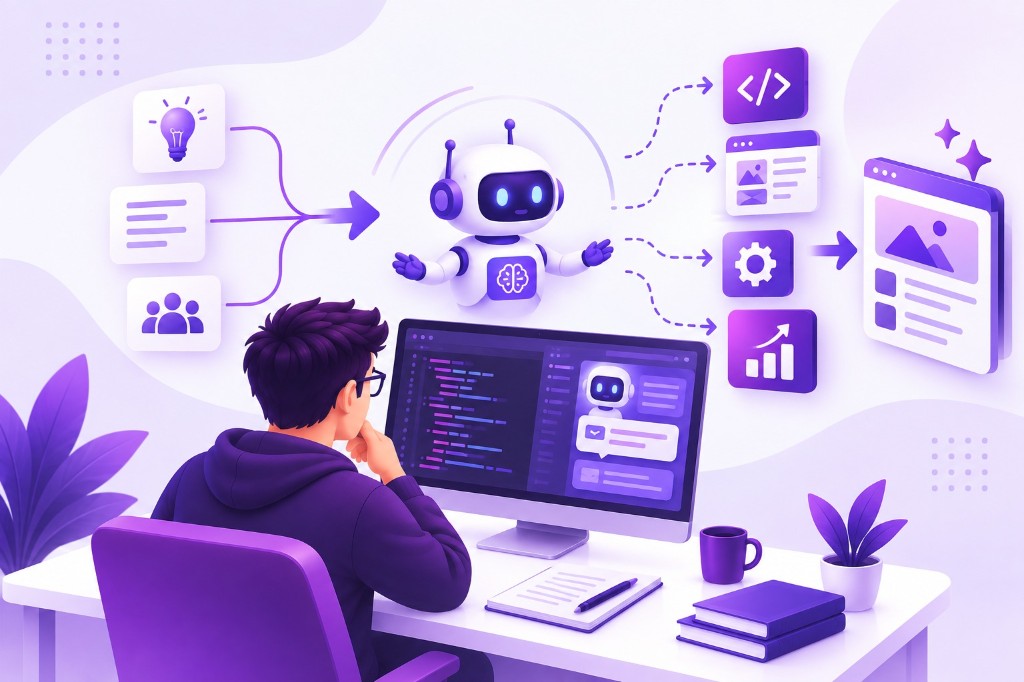
For a business owner, the useful question is not whether a supplier uses AI. It is how that supplier turns faster production into a reliable outcome. A screen created quickly may still contain incorrect assumptions about permissions, data, or the work your team performs. This guide explains what a responsible AI-first process looks like and what to ask before commissioning a project.
What changes in an AI-first workflow?
AI can assist with drafting user stories, comparing implementation approaches, creating interface variations, and writing routine code. It can also suggest tests or explain an unfamiliar part of an existing application. These are useful accelerators, but each output is a proposal rather than proof that the task has been completed correctly.
The main change is a shorter loop between a question and something the team can inspect. Instead of debating an abstract dashboard for a week, a designer can show an early version and ask users to complete a realistic task. The value comes from the decision that follows: keep the design, simplify it, or reject the assumption behind it.
Start with a business outcome, not a prompt
Write down who will use the software, what they need to accomplish, and where the current process breaks down. A useful brief might say: an operations coordinator needs to approve a supplier request without copying information between three spreadsheets. That is much stronger than asking for an intelligent operations platform.
Identify a measurable starting point. Record how long a request takes, how often information is missing, and which people must approve it. These details help the team choose features and later determine whether the software improved the work. AI should support this discovery, not replace conversations with the people who understand the exceptions.
Where does AI help most?
Well-bounded tasks are good candidates. Generating a form from an agreed data model, drafting a test for a known validation rule, or comparing two navigation patterns gives the reviewer something concrete to check. The narrower the task, the easier it is to spot a mismatch between the request and the result.
Large, vague requests are harder to verify. Asking a model to build the whole business system may produce a convincing interface while leaving important behaviours undefined. Divide work into reviewable changes and keep the underlying requirements visible. A human should be able to explain why each change belongs in the product and how its behaviour was checked.
An example: a supplier approval portal
Imagine a company that receives supplier requests by email. A focused first release could let staff submit a request, attach supporting information, and send it to the correct reviewer. AI might help draft the interface and routine validation. The project team still decides which roles can view documents and who may change an approval.
Testing should include more than a successful submission. What happens if a supplier sends the same request twice, an attachment is missing, or the reviewer leaves the company? Can someone bypass the interface and change another person's request? These questions turn a demonstration into a system that reflects how the business actually operates.
What should human review cover?
Review should cover the intended behaviour, the implementation, and the operational handover. A reviewer checks whether the application handles data consistently, enforces access on the server, and makes failures understandable. They also consider whether another developer can maintain the code after the original team moves on.
Useful evidence includes acceptance criteria, meaningful test results, a description of known limitations, and a record of major decisions. A supplier should not rely on the claim that the AI checked its own work. Independent checks matter because a generated test can repeat the same misunderstanding found in the generated implementation.
How should you compare delivery proposals?
Ask suppliers to separate discovery, prototype work, production development, and ongoing support. Understand which deliverables you will receive at each stage. A prototype may be intentionally disposable; a live application needs deployment arrangements, access ownership, recovery procedures, and a clear process for reporting problems.
Compare the proposed review process rather than the number of tools mentioned. Ask who approves architecture, how sensitive information is handled, and what happens when requirements change. Request a demonstration using your own representative workflow, with safe sample data. The strongest proposal connects its technical approach to business outcomes you can recognise.
A practical readiness checklist
- One primary user journey is defined, including its start and finish.
- Roles, permissions, and data ownership are agreed before implementation.
- Generated changes receive human review and appropriate testing.
- Important failure scenarios have visible, understandable outcomes.
- Hosting, support, backups, and handover responsibilities are documented.
- Success is measured against the original workflow, not just delivery speed.
Use the checklist at review meetings rather than treating it as paperwork completed at the end. If a decision remains unresolved, assign an owner and a date. Small unanswered questions can become expensive design assumptions once several features depend on them.
Frequently asked questions
Does AI-first development remove the need for developers?
No. Developers still interpret requirements, design systems, investigate failures, and take responsibility for the code. AI can reduce some drafting effort, but it does not remove the need to understand how the application behaves or to maintain it after launch.
Is AI-generated code automatically cheaper?
Not necessarily. Faster drafting can reduce effort on suitable tasks, while review, integration, and correction still require time. Compare the complete delivery cost and ongoing ownership requirements. An inexpensive first version can become costly if its structure makes future changes difficult.
Can an existing application adopt this approach?
Yes. Begin with a bounded improvement such as a reporting screen or a clearly specified integration. Establish the existing behaviour first, protect important workflows with checks, and review the change before expanding AI assistance across the application.
Your next step
Choose one workflow that matters to your business and describe its inputs, decisions, and desired result. Use that brief to evaluate an AI-first partner. A useful first conversation should make the problem clearer and identify what evidence would justify the next investment.
Sources and further reading
Official documentation for the technical topics discussed in this guide.